 The Rome Index
Public transport in Rome
Metro, buses, trams, tickets and Tap & Go — a practical first-timer guide to moving around Rome.
Rome works best as a walking city with transport for the longer jumps
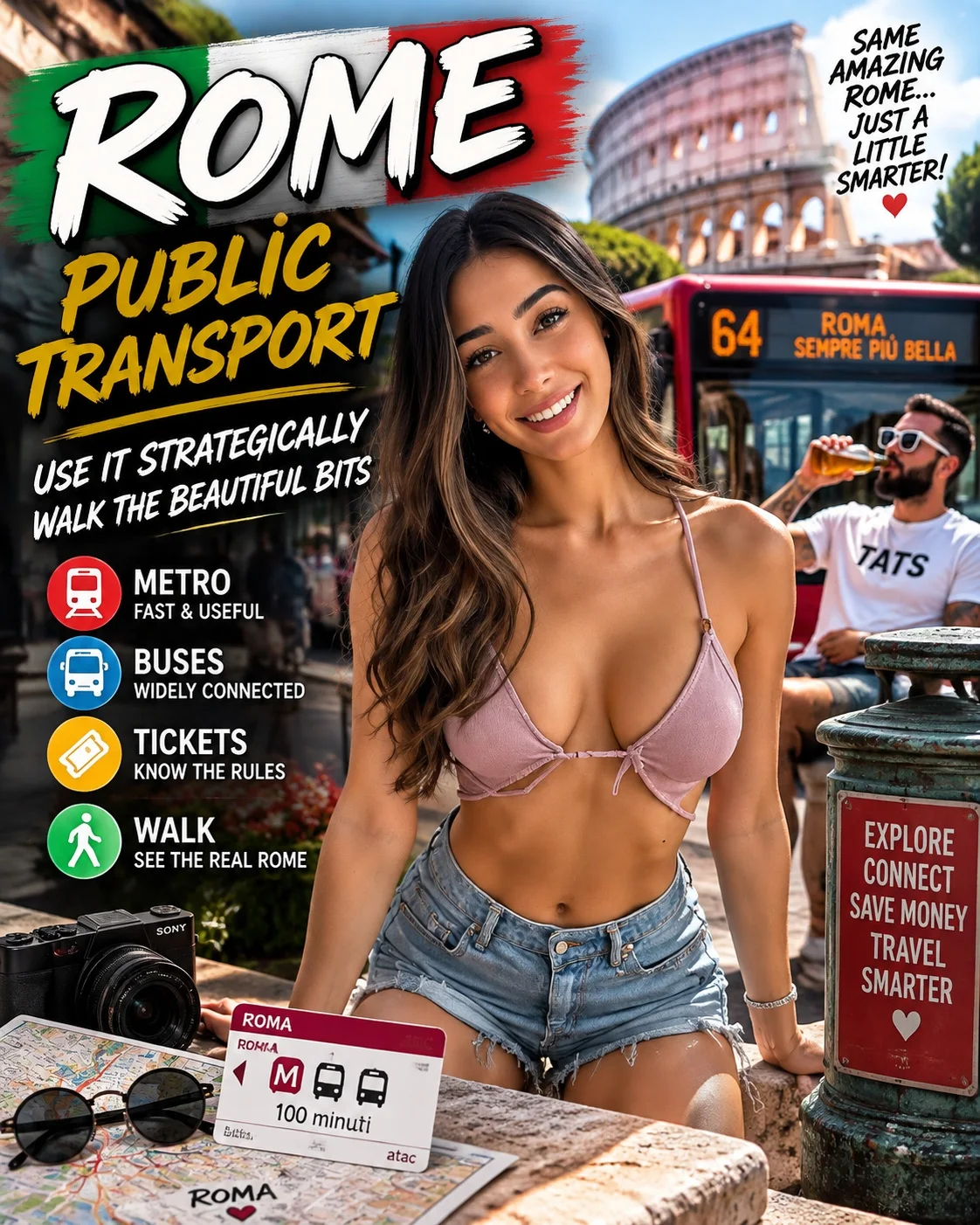
The historic centre is compact enough that many sight-to-sight trips are faster on foot, while metro, bus and tram are most useful for the longer legs. A practical day might use the metro to reach the Vatican or Colosseum area, walk between central sights, then take a bus or tram back to your neighbourhood. Trying to ride between every attraction often creates more waiting than it saves.
Metro: simple, fast and limited
Lines A, B/B1 and C cover important corridors but do not form a dense central grid. Termini is the major interchange for A and B/B1. Metro is usually the most predictable option when it matches your route, particularly at busy road-traffic times, but station works and extensions can alter entrances or interchange patterns, so follow current ATAC notices.
Buses: broad coverage, variable timing
Buses reach far more of Rome than the metro and are essential for many historic-centre and neighbourhood journeys. Traffic, diversions and road works mean the timetable is better treated as a guide than a promise. Check the live stop information before committing to a long wait, and if a walk is only 15–20 minutes it can be the more reliable choice.
Trams and urban rail
Trams are useful on selected corridors, while the wider city network also includes urban rail services. For visitors, the important point is not memorising every operator but checking whether your ticket is valid on the exact service you plan to board. Airport rail, especially the Leonardo Express, sits outside ordinary Rome urban ticket assumptions.
Current basic fares
ATAC's standard BIT ticket is €1.50 and is valid for 100 minutes from first validation. Current tourist products include Roma 24H at €8.50, Roma 48H at €15, Roma 72H at €22 and the CIS seven-day pass at €29. These prices are easy to verify on ATAC before travel and are more reliable than screenshots or old blog posts.
Tap & Go: convenient, but one traveller per payment device
ATAC's contactless Tap & Go works across much of the urban network. Keep using the same physical card, phone or watch for the journey and for best-fare calculation: switching between a physical card and the same card in a phone wallet can be treated as different devices. One card or device cannot be used to pay for several people travelling together.
How ATAC best fare works
For contactless users, ATAC calculates charges from the €1.50 BIT and can apply the current €8.50 24-hour best fare when the qualifying number of BIT purchases is exceeded within the 24-hour period. You still need to tap correctly when changing vehicles as instructed. If you are using several different payment methods, the system cannot combine them into one cap.
Paper and app tickets
Paper tickets remain useful for families or anyone who wants a simple shared purchasing process, but each traveller needs their own valid ticket. Validate as required before or on boarding. ATAC also lists authorised smartphone ticketing partners. Do not wait until an inspector appears to work out whether an unvalidated ticket is valid.
Airport transfers are a separate decision
Do not assume a Roma 24H/48H/72H ticket covers the Leonardo Express from Fiumicino. Airport transfer products and ordinary city transport have different rules. Ciampino has local public-transport connections, but direct airport coaches and taxis also operate; compare the whole trip to your accommodation.
Accessibility and luggage
Accessibility varies by station, lift status, vehicle and stop. Check the exact route rather than assuming every metro station is step-free. With luggage, avoid peak commuter periods where possible and keep bags clear of doors. A taxi can be worth the cost when a nominally simple public-transport trip involves several stairs and changes.
Apps and service information
Use the official ATAC website for fares, service changes and Tap & Go rules. Mapping apps are useful for route ideas and live arrivals, but treat operator notices as the source of truth when the two disagree.
A simple first-timer strategy
Stay near a useful metro or frequent-bus corridor, use contactless or the right-duration pass for your actual number of trips, walk the dense historic core and keep a taxi budget for late nights or awkward luggage days. That is usually easier than trying to optimise every single fare.